Monday, April 30, 2007

Lexar's 8GB ExpressCard SSD sneaks on the scene

Filed under:

While Lexar does a fine job competing in the flash memory arena, it appears that the outfit is giving it a go in the solid state disc realm as well. According a marginally descriptive product page, Lexar is offering up an 8GB ExpressCard SSD, which should go nicely above that 120GB PCMCIA NAND drive as you attempt to cram more storage into peripheral slots than inside your laptop's casing. Moreover, the device features a peak data transfer rate of 250Mbps, and while it doesn't appear to be available for shipment just yet, it'll run you a penny under $200 when it formally launches.

Read More...

Hip-IP's Mobigater Pro routes Skype calls to your mobile

Routing calls every which way has been going on forever (well, almost), and Hip-IP's Mobigater Pro doesn't differ a whole lot from other Skype-to-cellphone channelers that we've seen in the past. Essentially, the device seamlessly "transfers your Skype calls to your mobile phone without the use of SkypeOut credits," as it connects to your mobile via an internal SIM card. As predicted, it interfaces with your PC via plain ole USB, and users can not only ensure that they never miss an incoming Skype call, but they can phone up other Skype users around the globe just by using minutes from their mobile plan. The device can even redirect calls to five different handsets, but considering the £185.99 ($373) pricetag required for such a luxury, only the heaviest of yappers need apply. Click on through for a shot of the rear. [Via Wired]

Read More...

MIT researchers tout "practical" holographic video

Filed under:

A team of researchers at MIT seem to think they've finally come up with a way to make holographic video a bit more practical for everyday use, touting the new system they've developed as a possible display for PCs and video game consoles, Technology Review reports. According to the researchers, the display will be small enough to fit in an entertainment center when finished, boast a resolution as good as a standard analog television, and only cost a "couple of hundred dollars." Much of that increased practicality comes from the fact that this latest version, dubbed the Mark III, simply relies on a standard graphics processor instead of specialized hardware. The researchers also managed to streamline some of the other optical hardware, which they say made the previous incarnations as big as a dining-room table. It apparently still has a few drawbacks, however, with it currently only able to display monochromatic holograms in a space about the size of a Rubik's Cube. They insist that's only a temporary problem though, and promise that the next model will be comparable in size to a desktop monitor and boast a full range of color. No word if there'll also be a port of everybody's favorite quasi-holographic arcade game, Time Traveler, to go along with it, but we can hope.

Read More...

Friday, April 27, 2007

Convert Long, Complicated Web Addresses Into Small URLs

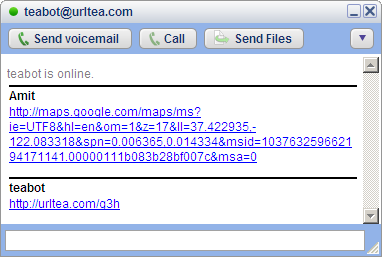
create short tiny url Here's a quick review of the most popular URL redirection servicesto help you pick the right one for your job. TinyURL.com - This is a name synonymous with URL redirection with maximum number of users. You can drag their bookmarklet in your browser and create short URLs in a single click. The advantage is that users can preview the web address embedded in TinyURL before visiting the actual website. With Preview, Without Preview urlTea.com - A relatively new but promising URL shortening service. It allows you to describe or annotate the destination website in the short URL itself. For instance, http://urltea.com/g20 is the same as http://urltea.com/g20?my_site but the latter makes more sense to the visitor. And you can also use Google Talk or Yahoo! Messenger to create short URLs through a buddy called teabot@urltea.com. short website address SnipURL.com - With SnipURL, you can choose your own web address with some meaningful text instead of using random addresses generated by tinyurl.com. This will help visitors get an idea of what they are about to click. It is possible to modify the underlying URL without changing the existing SnipURL address. Best of all, SnipURL can generate private URLs that can only be accessed after providing a password. Shorl.com - This may well be the favorite URL redirect service for bloggers and website owners since it provides usage statistics of your short URLs (i.e., Number of Hits). When a user clicks a URL created by shorl.com, he is shown the web address of the destination for few seconds before the actual redirection. Now that's an intelligent design since users can opt-out even after clicking the short URL. Nothing deceptive about it. Final Thoughts - Shorl.com gives control in the hands of the user and automatically increases the level of trust. SnipURL gives you click through stats and more control over URL text so that makes it my favorite URL shortening service. [I personally use these services for sharing hyperlinks in my newspaper columns that are published in the Hindustan Times and Financial Express.]
Read More...

ScratchYourself: Viral Sweepstakes That Brands Could Love

A new service called ScratchYourself came to our attention today. It’s a fairly simple Flash application that lets users upload an image and build a lottery-style scratch card from it. During the beta period people have a chance to win some very limited cash prizes that total $90 or so per day across all winners.

Once a scratch card has been created, users can email it to friends or embed it on their site. I created a quick scratch card with our logo and have embedded it below.

What interests me more than the front end, which would easily be duplicated, is the business model and payments infrastructure they’ve put in place. Users have an incentive to create and embed these on their blogs, MySpace page, etc.: if you create a scratchcard and someone wins a prize, you get the same prize as the creator of the card. Prizes are awarded, at the winner’s choice, via paypal, mailed check or amazon gift certificate.

The company’s business model is to attract advertisers to sponsor prizes (cash, products, coupons). If ScratchYourself turns out to be trustworthy and can circumnavigate the rather complicated federal and state regulations governing sweepstakes, brands could be attracted to this. You get a good long look at the image underneath the scratch area, which is more than can be said for most banner advertising. And publishers will like the ability to win the same prizes as their readers.

Shycast and Bix (acquired by Yahoo) are also experimenting with brand based contests, albeit through video (and Shycast is also a social network).

Read More...

Akamai Releases FoxTorrent 1.0 - Firefox BitTorrent Add-on

Red Swoosh (acquired by Akamai for $15 million earlier this month) released v1.0 of FoxTorrent today. This is a fully functional BitTorrent client for Firefox that works cross platform (Windows, Mac, Linux) and has a very cool additional feature - the ability to stream files as they are downloading.

This is no Azureus (my BitTorrent client of choice), but it does the job and saves time by allowing you to manage torrents directly from the browser. I tested it on a few (non-copyright infringing, of course) files and it worked great on the standard BitTorrent functionality. Streaming just didn’t work, although with the way the BitTorrent protocol breaks files into pieces and reconstructs them in a non linear way means you may have to wait until the file is mostly complete to even begin streaming. I’ll try it again once the files are nearly complete.

Read More...

Audiobaba.com - An Acoustic Similarity Search Engine

Audiobaba is a new kind of music search engine. You type in a song you like, and they give you a list of similar songs by other artists. You can listen to the sample of those songs, and if you like them, you can purchase them at Amazon or iTunes. The selection of songs they return is based on the acoustic structure of the selected. If what they returned doesn't sound similar to you, you can give it the thumbs down, helping their system to more closely match songs to each other that are more relevant. If you like a song in particular, you can add it to your bookmarks, or favorites. It's an interesting new way to find new music. They also offer their API to developers, sharing their new search technology. In their own words: "Audiobaba is a next-generation music search and recommendation engine. We realize that unless you know the name of the song you want, searching for music has so far been a pretty pathetic undertaking. Because there really is no better way to describe a song than "da da dee da da da", rather than using text to search for music, Audiobaba searches for music by fingerprinting the acoustic and impossible to articulate qualities of every song in its database and searches through them acoustically. We then further refine and personalize results as we receive feedback from our valued users."

Read More...

ScratchYourself: Flower Power

Read More...

Thursday, April 26, 2007

Stewart and Caterina

Flickr co-founders Stewart Butterfield and wife Catarina Fake. "He says many casual Flickr users want to sell their pictures but aren't sure how to proceed with copyright or payment. On the flipside, media companies would love to tap into the wealth of material but can't always find it or the photographer." source: http://www.cbsnews.com/stories/2007/04/26/tech/main2731568.shtml (thanks Andy!)

Read More...

Verizon/Vonage Lawsuit As A Proxy For What's Wrong With The Patent System

With the news that the federal appeals court has granted a permanent stay on enforcing the injunction placed on Vonage preventing it from signing up new customers, Tim Lee has written up a good article about how the case demonstrates many of the problems with the patent system, from software patents to obvious ideas getting patented to overly broad patents to the fact that companies are now using patents for nuclear stockpiling purposes rather than for innovation. It's an idea that we've discussed here quite a bit, and as Tim says, "Vonage's fundamental mistake was that it chose not to join this arms race. As a result, when Verizon sued, it was completely defenseless." We keep asking for people to explain to us how this is beneficial for promoting innovation, but no one seems to have a good answer. On a related note, Tim points out the latest ridiculous patent on tabbed windows, wondering "would anyone seriously claim that granting legal monopolies on the general characteristics of windowing systems is either necessary or helpful to the progress of the software industry?" Anyone?

Read More...

Group Of Banks Sues TJX Over Data Breach

One of the reasons that big data breaches, such as the one at TJX, keep occurring, is that there aren't sufficient incentives in place for companies to take this issue seriously. The key then is to develop ways for companies to see value in data security, and to be properly punished for their carelessness. At this point, the government doesn't seem to be doing much on this account, and even if it tried to do something, there's no guarantee that it would be effective, since many government regulations fail to achieve their desired goals. Now, a group of New England banks have filed a lawsuit against TJX, in hopes of receiving compensation for their own expenses from dealing with the situation. Their complaint seems legitimate since it's known that the breach has contributed directly to fraud, which is something that the banks themselves have to combat. As one representative from the group put it, "Right now we've had major breaches from major retailers, and there's very little recourse and little incentive for them to change." While the tort system is often abused, it can be used by legitimately injured parties to get compensation. If the banks are successful in winning damages, it's likely to open up a new (and hopefully effective) avenue in punishing companies that mishandle their data.

Read More...

Got A Good Credit Score? Rent It To Someone In Need

One of the common consequences for victims of identity theft is that they can see their credit scores get damaged, and because the big credit agencies don't offer much help in monitoring and fixing this, it can be a major hassle to get the problem resolved. Barry Ritholtz to an interesting story about a different kind of fraud, whereby people with good credit scores can sell their credit histories to people who want their own score boosted. Basically, the law states that people are allowed to add an unlimited number of individuals to their credit card accounts; it's mainly intended for parents who want to put their kids on the account. But, various websites have emerged to take advantage of this loophole, enabling people with bad credit histories to improve their score by getting access to a good credit history. It's not clear how widespread this actually is, but it pretty clearly violates the whole point of a credit score, since it's supposed to give the lender some idea of how reliable the borrower is. Fair Isaac, the company that developed the FICO score, says it's currently in talks with the FTC to stop the practice. The question, then, is whether shutting down this loophole will do the trick, or whether credit history brokers will simply find another loophole.

Read More...

Zipcar + ParkatmyHouse

Picture_2_2

London is host to one of the coolest and most functional partnerships we've seen recently. A collaboration that lets people share cars and parking places! It's hard to believe it's taken so long for something like this to come around...

ParkAtMyHouse is a new service that provides affordable and penalty-free parking around public venues by enabling property-owners to rent out their empty driveways, garages, car parks and other spare pieces of land to drivers needing somewhere to park. Anyone can register to rent out their parking space to consumers and/or businesses.

The new service has just partnered with ZipCars - another progressive company that allows users to rent cars by the hour or day. Users can book a Zipcar online or over the phone at any time, any day of the week. Then all you have to do is walk to the nearby car, unlock it by swiping your unique Zipcard across the windscreen and drive away with the minimum of fuss.

Read More...

BACKUP: Create easy online backups with Jungle Disk and Amazon S3

jungle%20disk.png

Tech columnist Mike Elgan has found what he considers the ultimate backup solution: Jungle Disk, a front end for Amazon's S3 storage service.

Jungle Disk puts a virtual drive on your computer that looks like any another hard drive. Unlike "regular" backups systems, you can browse, open, check and confirm the validity of every file in your backup by simply opening the folder, and using the files as if they were on your local hard drive. They're not locked away in a cryptic, proprietary system.

The Jungle Disk application lets you set up automated backups, which looks for any file changes in the files or folders you specify, then backs up any modified files at the frequency you set. You set it and forget it.

Jungle Disk is free while in beta; down the road it'll cost you $20 or $1 per month. As for S3, it's a pay-as-you-go service that costs 15 cents per gigabyte of storage and 20 cents per gigabyte of data transferred.

Those are pretty affordable rates, but you can accomplish almost exactly the same thing with MediaMax and Mozy, both of which are free. What do you think? Put your online-backup thoughts where they belong: the comments! —Rick Broida

Read More...

Wednesday, April 25, 2007

Alexa rankings today

Read More...

Create Animated GIFs Online - Photo Slideshows without Flash

GIF Animations [multiple picture frames in one file] can be used for creating image slideshows, screencasts, text banners or even stop motion animation movies. Some MySpace and MyBlogLog users also use animated GIF avatars to attract eyeballs. Animate GIF Photo Creator To create an animated GIF online, all you need is a set of images (in any format like jpg, png, etc) and Glickr.com, a free site that will convert them into an animated GIF movie of predefined sizes that you can use as profile avatars or post them on blogs. Individual images can be as large as 1 MB and you may directly grab your Flickr pictures inside Glickr.com. You may also change the speed of your animations [like how frequently the image transitions happen] Some people find animated images as annoying as blinking webpages but they are a good medium for sharing photo slideshows in situations where Flash is not an option. Glickr.com - photos in motion.

Read More...

Getty Images vs. Flickr

excerpted from Thomas Hawk's Digital Connection Thursday, March 01, 2007 Getty Images vs. Flickr Let's take this a step further though and look at Creative. This is the side of stock photography where marketers go to get images to sell things. Below are three searches that I selected at random. Las Vegas, candle and clouds. Now click through to the search pages for these terms at Flickr and at Getty Images. Which one is better? Is it clearly better? If you were a marketer would it make a difference to you which one you pulled your images from? Las Vegas Getty Las Vegas Flickr Candle Getty Candle Flickr Clouds Getty Clouds Flickr Now let's take this a step further and enter into the long tail of stock photography let's do a search for Tujunga (a small town in the San Fernando Valley where I grew up) and Mount Tam (a local mountain in Marin here in the Bay Area). Tujunga Getty Tujunga Flickr Mount Tam Getty Mount Tam Flickr Interesting what you get here isn't it? You see with 400 million images in their library Flickr is the better stock agency for long tail stuff for sure. The problem just is that Flickr hasn't figured out how to turn this on yet.

Read More...

Business 2.0 - Can Amazon.com Play Nice with Others?

source: http://blogs.business2.com/beta/2007/04/can_amazoncom_p.html by Owen Thomas excerpt "FlickrCash, a service which searches Flickr, likewise neglects to mention Yahoo's interest in the name."

Read More...

Founders, Founders and More Founders

by Darren Herman (4/4/2007)

Paul Graham of Y Combinator success has released an insightful essay about traits he’s studied with the early stage entrepreneurs he deals with each day that are part of his program up in Boston.

The essay didn’t just strike me about founders, but it struck me about Y Combinators success rate as well:

We’ve now been doing Y Combinator long enough to have some data about success rates. Our first batch, in the summer of 2005, had eight startups in it. Of those eight, it now looks as if at least four succeeded. Three have been acquired: Reddit was a merger of two, Reddit and Infogami, and a third was acquired that we can’t talk about yet. Another from that batch was Loopt, which is doing so well they could probably be acquired in about ten minutes if they wanted to.

That’s pretty darn solid if you ask me. I do not know anyone personally who has been through the Y Combinator, but based on the essay that Paul has written and the statistics, the numbers certainly look positive.

In the essay that Paul has written, he talks about many reasons why people do not become entrepreneurial and talks about why those reasons should be ignored. The topics covered are:

  1. Too young
  2. Too inexperienced
  3. Not determined enough
  4. Not smart enough
  5. Know nothing about business
  6. No Cofounder
  7. No idea
  8. No room for more startups
  9. Family to support
  10. Independently wealthy
  11. Not ready for committment
  12. Need for structure
  13. Fear of uncertainty
  14. Don’t realize what you’re avoiding
  15. Parents want you to become a doctor
  16. A job is the default

Read More...

Download of the Day: HandBrake (All platforms)

handbrake-win.png

Windows/Mac/Linux: Rip DVDs to your iPod with HandBrake, the latest version of the program previously known as MediaFork.

HandBrake can turn DVDs into iPod-friendly MPEG-4 or H.264 video files. It includes iPod, Apple TV and even Sony PS3 presets, but you can also customize various audio and video settings to your liking. (Needless to say, the ripped files will also play on Zunes and other devices.)

Windows users can choose between GUI and CLI versions; both require DVD43 to be installed if you want to rip copy-protected DVDs (the ones you own, of course). Also, be sure to choose the VIDEO_TS folder when you browse the DVD, and then select the "title" that contains the actual movie (it's usually the longest one). For Windows users in particular, HandBrake definitely makes easier work of copying DVDs to your iPod, though the overall process still takes a few hours.

Still in beta, HandBrake is free; it's available for Windows, Mac and Linux operating systems. —Rick Broida

Read More...

Samsung builds a better, smaller 4GB DIMM

OCZ may have recently laid claim to the title of some of the world's fastest RAM, but Samsung seems to have found room to do a little boasting of its own, trotting out its first 4GB DDR2 DIMM based on WSP (or wafer-level-processed stacked package) technology. According to the company, that process not only makes the module smaller, but faster and more energy efficient as well. Not so clear, unfortunately, is what effect the seemingly cure-all technology will have on pricing or availability, with no word on either from Samsung as of yet.

Read More...

The Miracle Polymer for the New Millennium

ETFE can be made into glass-like sheets or inflated in pillows and is being used in some of the most innovative new buildings around the world By Elizabeth Woyke (BusinessWeek) ETFE (Ethylene Tetrafluoroethylene) is the building material of the future. This wonder polymer, a transparent plastic related to Teflon, is replacing glass and plastic in some of the most innovative buildings being designed and constructed today. Its selling points? Compared to glass, it’s 1% the weight, transmits more light, is a better insulator, and costs 24% to 70% less to install. It’s also resilient (able to bear 400 times its own weight, with an estimated 50-year life-span), self-cleaning (dirt slides off its nonstick surface), and recyclable. Architects started working with ETFE some 15 years ago. The material will soon get a boost with the 2008 Beijing Olympics, where it’s an integral part of the distinctive designs of both the Beijing National Stadium and Aquatics Center. Here’s a sample of the most ambitious and creative architectural projects around the world that utilize ETFE. Read the story

Read More...

This Video Says A Lot About Where The Music Business Is Today

When I see a lot of Google traffic coming to my blog, I check the feedburner stats and yesterday the search term Fluorescent Adolescent was generating some meaningful traffic. Flourescent Adolescent is the name of my favourite track on the Arctic Monkeys new record which is coming out next week. I don't have the record, but I've heard most of it on the Hypemachine.

So I googled Fluorescent Adolescent and sure enough my post linking to the track was number one. Number two was this video, taken at an Amsterdam show last month, probably on a cell phone or something like a cell phone.

First of all, this song has not been released. But this video has been viewed almost 16,000 times on YouTube in the past month. I am sure some people have watched it multiple times, but surely over 10,000 people have gotten introduced to this song in the past month, some portion of whom are likely to buy the record.

Second, this is not the first single, that would be Brianstorms, a good track, but not my favourite. But in effect, there's already a "video" on YouTube promoting this track.

Third, this was shot by a regular fan, uploaded to YouTube, and the quality and sound are pretty damn good for someone five or six bodies back.

Fourth, this was shot at a club in Amsterdam and is available to the entire world via YouTube instantly (or as soon as the person who shot it uploaded it).

Fifth, check out how many others in the crowd are taping the performance with their cell phones and cameras. Has to be at least five or ten others in the video doing that.

Lefsetz says in one of his recent posts:

And trust only grows person to person now. NOBODY trusts the machine.

Let's look at what just happened here. Somebody got a hold of the Fluorscent Adolescent track and uploaded it to their blog. It made the Hypemachine. I heard it there and reblogged it. My post went to the top of Google for that search term. I googled it (but you could have too) and found the YouTube video posted by another fan. I saw that and reblogged it just now.

Person to person marketing. No machine other than the web and google at work here. The rest is us, enjoying a song, a band, and music on the web.

Read More...

Which mobile Skype client will win?

Skype’s lack of desire to release a mobile client has opened a small window of opportunity for a few start-ups - iSkoot, Mobivox, and EQO. These companies are creating clients that run the Skype service inside a server farm, and allow you to make and receive Skype calls on your mobiles. It is no surprise, that they have received major infusion of venture dollars.

The latest to get a big fat round of funding is EQO, that just announced that it has raised $9 million from Venture West, Growth Works and BDC Capital. The company has raised over $12.5 million in funding.

EQO is also benefiting from VC interest in mobile VoIP, though I have some serious questions about the potential payoff. The big question, however, is that which of these three will emerge as an eventual winner. Will it be Skype, that will finally release a mobile client of its own? (Skype currently offers a Windows Mobile version of its client, though its functionality is limited.) Have your say in our poll.

Read More...

Newsvine Relaunch Today: Build Your Own News Site

Seattle-based news site Newsvine will relaunch this afternoon with significant changes to the user experience. They’re calling the release “Evergreen.”

Among the changes: like Netvibes, Pageflakes and other personalized homepages, users will now be able to move most modules on the Newsvine home page around, or delete them altogether. Users can also add whatever news feeds they want to the home page by adding a RSS feed module.

Until now, web services that allow customization generally put the feature in a standalone area. Yahoo has my.yahoo, for example, but doesn’t allow users to make changes to the main Yahoo home page. Like their often-copied feature of allowing user comments to news items, this may be another way that Newsvine reshapes the online news industry. I wouldn’t be surprised to see the New York Times, USA Today and other sites allow users to create their own version of the newspaper, possibly even allowing outside RSS feeds in, in the next year or so. This builds intense user loyalty and makes it much more likely they’ll spend even more time on the site.

Other features include the addition of local headlines and weather and a slideshow called “News In Pictures” that shows a continuous stream of AP pictures.

Newsvine also just got bigger, stretching from 900 to 1240 pixels. The extra width can be collapsed with a click.

Newsvine has raised just $1.25 million in a single round of financing in July 2005 from Second Avenue Partners. They have six employees. The site currently brings in 600,000 monthly unique visitors generating 3.5 million monthly page views.

Read More...

Tuesday, April 24, 2007

Cameraphones Pass 50% Penetration Mark in USA

M:Metrics says that the number of cameraphone owners has climbed to 106 million in the United States, crossing the 50% threshold. Cameraphones are even more ubiquitous in European markets, led by the United Kingdom where three out of every four mobile subscribers own a camera phone. The measurement firm reports that the proliferation of this technology is driving a decline of one of the first sources of mobile entertainment revenue: the sale of wallpapers and phone graphics, as increasing numbers of people personalize their phone with photos taken on the device.

Cameraphone Penetration and Graphics Purchases: February 2007

CountryPenetration% Who Purchased Screensaver or Wallpaper% Who Saved Camera phone Photo as Screensaver / Wallpaper
US51%3.316.7
UK75%2.028.3
Germany70%2.020.4
France63%2.126.6
Spain74%2.631.2
Italy69%2.931.7

"While a cameraphone in the pocket of most mobile phone owners may have picked the proverbial pockets of graphics publishers, the penetration of this technology has a positive impact on operator data revenues overall as consumers increasingly purchase photo messaging bundles," said Mark Donovan, senior vice president and senior analyst, M:Metrics.

Despite a slackening of demand for graphics, Donovan notes that such content is used to good effect by purveyors of off-portal content to entice subscribers to sign up for subscriptions. "Graphics remain a preferred type of content because of the more attractive terms typically associated with licensing of branded graphical content compared with the revenue splits that music labels and publishers expect from ringtones. However, graphics publishers have to work a lot harder and offer compelling, branded content to generate consumer interest."

Photo messaging has consistently been among the most popular mobile applications across geographies that M:Metrics measures, with as many as 31.3 percent of mobile subscribers sending photos or videos to other phones, e-mail addresses or posting to blogs.

Used network services for photos/videos

August 2006February 2007
CountrySubscribersPercentSubscribersPercent
France8,796,96020.59,432,84221.2
Germany9,238,96820.59,590,28120.8
Italy13,156,34231.313,779,05931.3
Spain8,671,45228.49,316,64429.1
UK13,363,23330.713,187,92929.6
US28,218,33614.530,692,54514.8
"As the technological abilities and habits of mobile users evolve with the capabilities of the devices they own, new mobile content business opportunities are both created and destroyed," observed Donovan. "As we reported, the proliferation of musicphones is also expanding rapidly, so a natural question is how the music industry will respond as these connected creators potentially take a bite out of the ringtone market."

Read More...

5min: A collective encyclopedia in form of 5 minute videos

(Thanks, Trebor!)

5 mins combines several different smartmobby ideas and technologies in an excellent way: User-generated short videos, collective knowledge creation, peer-to-peer media sharing, open educational content:

5min is a place to find short video solutions for any practical question and a forum for people wanting to share their knowledge.

The vision behind 5min is a very simple one: any solution can be visually explained in no more than 5 minutes. Our aim is to create the first communal Life Videopedia allowing users from all over the globe to contribute their knowledge by sharing visual guides covering arts, business, fashion, sports, health, tech, food, and much more.

5min's basic philosophy is that everybody is an expert in something. The video era gives us the technological opportunity to share our collective knowledge and gather it onto one platform. This is what 5min aims to be – a platform for users, a platform for creators, a platform for talent and anyone that has something to teach.

In order to bring to life our vision of creating a comprehensive Life Videopedia, 5min gives each creator a private promotional Studio – a space to show his/her skills, and share his/her secrets.

Read More...

Kyte Launches: More Rich Media Streaming Presence

Keeping everyone aware of what you are up to every fleeting, uninteresting moment of your life is a hot area for startups right now. Newly launched Kyte seems to fall somewhere between Twitter and Ustream, two services that let users send a constant stream of data about themselves to interested friends (albeit in very different ways).

Kyte is at its core a media player. Users create an account and set up channels. They can then drag photos, video and text into the channels and interact with people viewing the content.

The service is extremely flexible in its approach to getting content into and out of the service. Users can access their account and add content from their (java enabled) mobile phone, the browser or via email. Viewers can interact with content on the Kyte website, their phone and other websites where users embed content via a widget player.

Kyte can be a place users put occasional content, or a live, Usstream-style live stream of their life. The company says “You could even create a “LifeStream”, a minute-by-minute live show that is published in real-time directly to your MySpace page, website, blog, or mobile phone.”

The company has raised a round of financing ($2.25 million, says Om Malik) from Atomico Investments, Draper Fisher Jurvetson, Draper Richards and Ron Conway.

Read More...

OpenDNS Adds Short-Cut Service

DNS is boring, but OpenDNS has added a new Shortcut feature that lets you visit URLs without all that nasty typing. Shortcuts are short, multi-letter abbreviations for your favorite sites. Instead of typing “www.nytimes.com,” you can just type “NYT.” You can also create short-cuts for popular search sites (”g monkeys” to search Google for Monkeys, for example).

Read More...

Tiny Startup Mozy Nails Multi-Million Dollar GE Storage Contract

Online backup and storage service Mozy has quietly grown to 175,000 customers since launching in April 2006. That’s not bad for the Utah-based company that runs the service, Berkeley Data Systems, which raised just $2 million in venture capital back in 2005. The company went big time today, however, when they announced a multi-million dollar deal with General Electric, which bought MozyPro (the enterprise version of Mozy) for all of its 300,000+ worldwide employees.

MozyPro is similar to the consumer Mozy service, but includes server backups, 24/7 support and admin control for the IT department. The service launched last December and 3,200 businesses are now using. GE is now one of those businesses.

Mozy and MozyPro are administered through a desktop client and automatically backs up data on the PC every two hours. Thirty days worth of versions are retained, and users can go back and restore any of those versions.

Rate card pricing for consumers is free for up to 2GB of storage, and $5/month for unlimited storage. Businesses pay $4/month for each employee, plus $0.50/GB/month of stored data. Bandwidth is free. As a side note, GE certainly didn’t pay rate card rates - a deal this large would have a substantial discount.

The company is backed by Wasatch Partners, Tim Draper and Drew Major. They have 25 employees.

We first mentioned Mozy back in 2006 when we covered the major online storage providers. On the consumer side, Mozy competes with Carbonite and others. At the enterprise level, Iron Mountain and EVault are the entrenched competitors, although Mozy says they have a 10x cost advantage over those services. Google and Microsoft will also have products in this space.

A very large untapped market for online backups are the OEM PC manufacturers, who should be providing a free trial with every PC. Mozy is now positioned nicely to land such a deal. After a grueling due diligence process by GE, the PC guys should be confident that Mozy is as secure as their competitors. And charging 1/10 of what they do is great for the bottom line.

Crunch Network: CrunchBoard because it’s time for you to find a new Job2.0

Read More...

JS-Kit: Web 2.0 For Lazy People

We first covered JS-Kit last November when we talked about their quick embed code that lets you add comments to any site where JavaScript is accepted. Since then, JS-Kit has been creating more widgets making adding user interaction to any site dead simple (2 lines of code per widget). JS-Kit has also grown from a one-man-show into a full company after adding 5 of the 12 engineers from Filmloop (which shut down earlier this year). Since then, they’ve been turning out a new widget every two weeks.

JS-Kit is growing a suite of widgets that will help site owners optimize their website content, eventually allowing website owners to easily optimize their site based on how people surf their site. Think Baynote, but for the little guys.

JS-Kit’s current widget suite consists of comments, five-star ratings, and a polling widget added this week. The new polling widget supports an unlimited number of questions, an expiration date, and only becomes visible after the site owner publishes it. Each widget has a fully customizable look through CSS and consists of two lines of code. The first line is a “div” tag brought to life by a second line of JavaScript code.

Each widget is by default differentiated by the URL of the page it is installed on, but can also be given a unique identifier by the user so that a page can have multiple instances of a widget, such as founder Lev Walkin’s photo site. JS-Kit is combating fraud by logging a combination of user cookies, IP, and user agent. The degree of this security can be throttled by the administrator. However, one major disadvantage of the JavaScript implementation is that it will not run on sites that break JavaScript code (MySpace).

spotlight.pngEach widget also has administrative capabilities, assigned by cookie to the first computer to accesses the widget code. The administrator is able to moderate any comments that Akismet’s spam filter may miss or create new polls. JS-Kit has a user settings page that lets you view your activity across JS-Kit sites and reclaim administrator rights on a domain if you switch computers or lose the JS-Kit cookie.

To make these more than just website web 2.0 “bling”, JS-Kit is letting the widgets talk to each other. So far they’ve integrated comments and ratings into one widget that allows people to leave comments along with their individual rating, which combine on the server side into one overall rating for the object the widget is attached to. On top of these widgets, JS-Kit will be releasing a meta-widget later this week so that surfers can receive recommendations for your site’s top content (pictured right).

Comment and rating widget after the jump… (more…)

Crunch Network: CrunchGear drool over the sexiest new gadgets and hardware.

Read More...

Ten Minutes with ShoZu

Shozu-logoWhat is it: ShoZu is a free service to ease uploading of video, photos and music from your cellphone to the Web. The company calls itself “a provider of mobile media exchange services” and describes its services (quite succinctly as) allowing “consumers to download and upload photos, videos, music, text and other digital content to and from the handset without the need to open a mobile browser, wait for pages to load, interrupt phone calls, start over in the event of a dropped connection, or sync to a PC.”

Exec summary: It does what it promises to do. Well.

Shozu2My ten minutes: Sign up is easy and free of dodgy and misleading byways (“invite your friends! Oh, we already have!”) Once you’ve given the basics and have an account (free) you need to download the software. This is usually where things get painful, but I didn’t find them to be with ShoZu. Enter your phone number, get an SMS message with a link in it, and download it from there. The software works with most phones, although I noticed Palm OS is not supported (Windows Mobile Treos are.)

ShoZu doesn’t actually host the photos and stuff, so you need to have an account with another provider. In fact, this is a blessing: Who needs another account? It’s an impressive list of services that ShoZu works with, from Flickr to the BBC’s news photo submission service. You can configure settings with your accounts on any or all of these services, either on a computer or on your phone.

Shozu1Once the software is installed on your phone, just take a photo or video and a menu pops up asking whether you want to post said multimedia work there. Say yes and off it goes in the background. The only sign that something is happening is, at least in a Nokia phone, a little arrow in the corner of the screen.

There are other parts of ShoZu worth a look. You can, for example, back up all your phone contacts securely to a website, if you like. You can add GPS tags to photos, if your phone supports it. There are things called ZuCasts which are like mini TV programs downloaded to your phone in the background.

Quibbles? Couldn’t see any easy way of adding more than one phone to an account, meaning you’d have to have more than one account. Who doesn’t have more than one phone these days? Also, I could never be quite sure on my phone what photos had actually been uploaded. I only discovered I’d backed up my contacts when I wandered around the website. Would be better to get some email notification of this, although one can subscribe to an RSS feed of everything one has uploaded.

Verdict: If you take photos on your phone and haven’t found an easy way to share them away from your computer, give it a shot.

Read More...

Saturday, April 21, 2007

The two reasons people say no to your idea

"It's been done before" "It's never been done before"

Even though neither one is truthful, accurate or useful, you need to be prepared for both.

Read More...

Ramp generates electricity from cars passing over it

Mark Frauenfelder: 200704181449 Here is a proposal for an energy generation system. The idea is to pump a generator when a car drives over panels attached to the generator.
I hope the people who came up with this idea realize that the energy they get from the generator will be less than the extra fuel the car must to burn to drive the generator. Link Jon-o says:

Mark mentions that this will just result in more gas being burned by cars, completely offsetting any power generated, but cars spend a lot of time *braking* as well -- if a device like this was put near the bottom of a downward slope, or somewhere else where cars need to slow down, it would be making use only of energy that would otherwise be wasted as heat in the brakes.
(Would this work for hybrid and electric cars that use regenerative braking, too? -- Mark)

Daniel says:

My first thought at seeing the title of your post on the electricity generating ramp was that it would be energy inefficient, but then I realized that if it were on a downhill where you would be breaking anyway, it doesn't matter if it slows your car down - it's a little side benefit and less wear on your breaks. Their YouTube video of it is stupid and wasteful, but the idea doesn't have to be. Also, using it as a speedbump as implied by the article is another bonus, in areas where that's necessary.

Read More...

US exposes 1000's of SSNs for years in web-accessible database

Xeni Jardin: Tens of thousands of social security numbers belonging to Americans who received loans or financial assistance from the government were exposed for years in a publicly accessible database. Snip from New York Times article:
Officials at the Agriculture Department and the Census Bureau, which maintains the database, were evidently unaware that the Social Security numbers were accessible in the database until they were notified last week by a farmer from Illinois, who stumbled across the database on the Internet.

“I was bored, and typed the name of my farm into Google to see what was out there,” said Marsha Bergmeier, president of Mohr Family Farms in Fairmount, Ill.

The first link that appeared in the search results was for her farm’s Web site. The second was for a site that she had never heard of, FedSpending.org, which provides a searchable database of federal government expenditures. The site uses information from the Census database.

Ms. Bergmeier said she was able to identify almost 30,000 records in the database that contained Social Security numbers. “I was stunned,” she said. “The numbers were right there in plain view in this database that anyone can access.”

Link

Reader comment: Gabriela says,

I saw your post on BoingBoing about the USDA privacy breach that The New York Times reported and wanted to let you know The Sunlight Foundation just unveiled a new project -- Real Time Investigations – that also had exclusive coverage of this story and blogged about it moments before the Times piece ran.

Real Time Investigations is an open source journalism effort that reveals the behind-the-scenes research involved in petitioning the federal government to make its information more accessible to citizens, constituents and journalists. We first learned of the extraordinary privacy breach by the USDA when a user of FedSpending.org, an online database of government spending created by OMB Watch and funded by us last year, reported it to OMB Watch late last week.

Read More...

Download Multiple Flickr Pictures in a Batch [Original Images, not Resized Thumbnails]

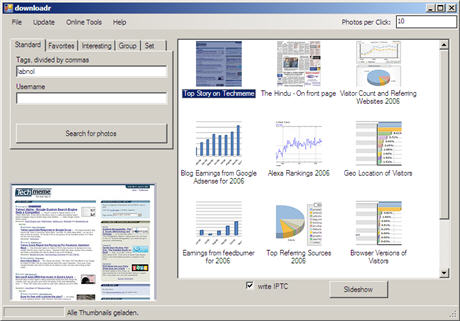
Allagappan from NIT Trichy is looking for some Flickr mass downloader tools to help him choose and download Flickr images in bulk from flickr.com website to the hard-drive. It's so surprising that Flickr doesn't provide an official tool for downloading images from their website but thanks to the API, Flickr enthusiasts have developed some excellent Flickr Photo downloading tools and our favorite is Downloadr. Download Flickr Pictures in Bulk Think of Downloadr as an offline browser for Flickr photos. [Get Downloadr Windows only, ~300kb zip] With Downloadr, you can search, browse and batch download multiple Flickr pictures based on image tag (s), Flickr username, Groups Pools, Flickr user sets or even Interesting Flickr pictures of any particular day. Images are fetched only from public Flickr photostreams though you have an option to authenticate and download your private Flickr pictures via Downloadr. The developer homepage is in German but the tool itself has an English interface. More discussion on the Flickr groups. If you are using Flickr, Downloadr is a must have utility. Related Flickr search tools - FlickrCash, Flickr Leech
© 2007 Digital Inspiration - Technology, à la Carte | Subscribe | About Us

Read More...

Friday, April 20, 2007

Google Web Conferencing Software has Full Screen Video and Application Sharing

Google has officially entered the turf of WebEx, Microsoft Live Meeting and Adobe Connect with the acquisiton of Marratech, a web and video conferencing company based in Sweden. There's a possibility that Google will integrate Marratech web conferencing features into Google Apps Primer and Google Office to make these "virtual office" offerings more complete and compelling for the corporate world. The Marratech video conferencing client is done in Java and available for Windows, Mac and Linux platforms. But it is possible to participate in Marratech meetings via the web browser without downloading the Marratech client. Currently, the Marratech client is free while companies are required to license their server software. Like other web conferencing software, Marratech allows users to hold virtual e-meetings and share application sceens, webpages, images and documents in the Whiteboard area. Participants can use annotation tools like pointers and markers to highlight presentations or draw on the screen. Marratech video conferencing client allows participants to see other in real time using web cameras. All participants can record and playback the entire net meeting including voice, video and whiteboard.Download Marratech brochures - Client, Server
© 2007 Digital Inspiration - Technology, à la Carte | Subscribe | About Us

Read More...

ImageKind Scores Partnership With Flickr

When we wrote about Photo printing site ImageKind in February, the company said they were close to announcing a large portal distribution partnership.

Earlier this month a reader suggested to us that the partnership might be with Flickr based on some code that appeared on the ImageKind site that accessed the Flickr API. Today, that reader turned out to be right - Flickr launched integration with ImageKind. Flickr users can now create very high quality framed prints of their photos for themselves, or sell them through an online store. More information on the Flickr partners page where they also show the moo, qoop and Zazzle integrations…

Crunch Network: CrunchBoard because it’s time for you to find a new Job2.0

Read More...

Thursday, April 19, 2007

Groundbreaking Study estimates size of Stock Footage Industry at $282 million

(source: StockPhotoTalk.com ) ACSIL Global Survey of Stock Footage Companies 2007 provides an inside look at footage industry

New York, NY, April 2, 2007. The Association of Commercial Stock Image Licensors (ACSIL) has completed the ACSIL Global Survey of Stock Footage Companies 2007, a comprehensive and detailed examination of the issues and challenges faced by leaders in the footage-licensing field.

Coming in at 259 pages, the report covers a broad spectrum of critical topics including:

  • the state of digitization;
  • the nature of current license agreements and rights packages;
  • the emergence of new markets and customer types;
  • changes in order volume; and
  • current approaches to marketing and new business development.

In addition to survey data collected from 67 key footage companies, the Global Survey includes an analysis and index of the global stock footage industry by estimated revenues, content type, web-functionality and region.

"This report allows individual companies to understand their own performance within the context of the broader industry," said ACSIL Co-President David Sheehan. "And to have so many participants share information is one of the many delightful outcomes of commissioning this study."

The Global Survey takes a bottom-up approach to estimating the dollar size of the total footage industry, focusing specifically on a group of 355 active, commercial footage companies/departments identified as part of the study. The estimate of total industry annual revenue ($282 million) is built from the sum of the individual revenue estimates applied to each company.

"There is so much information in the report and the synthesis is really a joy to read," said Peter McKelvy, Vice President of Footage and Music Services, Discovery Communications Inc. "For me, educating an executive team in a large company about the footage sales business, this report will be invaluable."

The industry was also analyzed based on a variety of other aspects including geographic distribution. For example, 48% of the companies analyzed in the Global Survey are based in the United States, accounting for $170 million in gross revenue or 60% of the global market. 24% are based in the UK, accounting for $63 million.

Please visit www.thrivingarchives.com for more information on obtaining a copy of the report.

About ACSIL

Founded as a non-profit trade association in early 2003 by a group of leading stock footage companies and news agencies in the United States, ACSIL is focused solely on the commercial interests of the stock footage industry, and meeting the demand for market data on this industry is central to ACSIL's mission.

About Thriving Archives

Thriving Archives is a market research and business development consultancy focused on addressing the unique challenges faced by stock footage companies.

Read More...

Publishing site Lulu partners with Getty Images

Published: April 19, 2007, 7:02 AM PDT
Lulu.com, a site that lets members publish, print and sell their own books, has entered into a multiyear agreement with stock-photo giant Getty Images.

In this deal, Getty will provide its royalty-free--but still copyright-protected--image database to Lulu so that its members can use the contents in their self-published books, photo books and calendars. Lulu has emphasized the copyright-friendly nature of the agreement, explaining in a release that the high-resolution version of a Getty image is not "married" to a Lulu book until right before production. This way, according to Lulu, digital rights management restrictions on the stock images are honored.

Partnering with a company that specializes in copyrighted images is somewhat unusual for a company like Lulu, whose roots are definitively open source. The self-publishing site was founded by Robert Young, who co-founded Red Hat Linux along with Marc Ewing in 1994.

In addition to offering self-publishing on demand to members, Lulu has also sold titles from the Internet Archive's Open Library, considered by some to be an open-source equivalent to Google's controversial Library Project.

ulu touts 200,000 recently published titles with more than 5,000 additions each week. In addition to selling self-published books, the site also offers e-books, CDs, DVDs, and music and software downloads, with editorial and copyright control in the hands of the individual publisher. There's no fee to publish on Lulu, but the site does take a commission from each sale.

The Getty database will be available to Lulu members beginning this summer.

FlickrCash similarly offers FREE, LICENSED images from Flickr TODAY http://flickrcash.com

Read More...

VA Tech shootings: world perspective

News veteran and media sage Dan Gillmor has a thoughtful op-ed online today about online, "conversational media" response to the Virginia Tech shootings, and what's different this time. Snip:
I didn’t turn on my TV yesterday except in the evening, to watch a national network’s news report. I wanted to see a summary of what a serious journalism organization had to say about what it knew so far.

Instead, during the day, I used the online media — including the major news sites — to get the latest information, sifting it, making judgments about credibility and reliability as I read and watched and listened. That, too, is the future in many cases. It’s also worth noting that the citizen media component of this terrible event is not a new to the digital era. When President John F. Kennedy was gunned down in Dallas back in 1963, Abraham Zapruder caught the gruesome killing on a home movie camera — footage that became an essential part of the historical record. But the difference between then and tomorrow is this: In 1963, one man with a camera captured the event on film. In a very few years, a similar situation would be captured by thousands of people — all holding high-resolution video cameras — and all of those cameras would be connected to high-speed digital networks.

Read More...

Academy Award-winning film released under Creative Commons

A reader writes, In 1997, a Dewey-Obenchain film crew accompanied an Interplast volunteer surgical team to An Giang province in Vietnam's Mekong Delta. The filmmakers donated their services to document the team's experiences and produce "A Story of Healing," which earned the 1997 Academy Award for best documentary, short subject. The 28-minute film is followed by a short epilogue (after the credits) which follows-up on two patients 16 months after their surgeries.

Ten years later, Interplast is proud to announce that "A Story of Healing," has been released under a Creative Commons Attribution-Noncommerical-No Derivatives license (by-nc-nd) and is available for free online.

It should be a no-brainer, especially for mission-driven non-profits, but this is the first time that an Academy Award winning film has been licensed under any Creative Commons license.

Read More...

Moo launches notecards

Moo, the killer printers who make custom, kid-sized business-cards from your Flickr stream, Second Life, or Habbo stuff, have just launched a new product: note cards.

Moo Note Cards are little note-sized cardboard sheets, with envelopes, that are printed with your Flickr pix. Just like with Moo Cards, you can pick a different image for every card. I ran out of business cards a couple months ago and switched to my Moo Cards and I've never gotten so many compliments. The print quality is superb, and I love that each one has a little story for the picture I took for it.

Well, to put it bluntly, we miss mail. Not email - we get that by the bucketload - but real post. Post that isn’t a utility bill or something boring. So we dreamed up NoteCards - square prints made from up to 16 of your own photos or designs. They have a magic folding-flap down one side, to make them stand up proudly on your bookshelf or windowsill, and they’re the perfect size to mail to friends...

You can personalise the back of your cards in two different ways. There’s 6 lines of larger text for a main message, and at the bottom of the cards, there’s 4 lines of small text, for things like a photographers credit, the name of the photo, or your website url.

Read More...

Google Makes It Easier For Sites To Cut Off Free Publicity

Google's found itself on the end of some lawsuits from people who aren't happy that it links to their web content, usually making the off-base accusation that Google's somehow stealing their content, rather than realizing it makes it more valuable by making it easier to find. While a robots.txt file or the use of meta tags already gave web masters a relatively simple way to keep their content out of Google and other search engines, that apparently wasn't enough, so Google has beefed up its site removal tools, giving webmasters several new ways and options to control how their pages are indexed and displayed in its results. Will this stop the lawsuits and complaints? That's doubtful, since the existing ability for site owners to get themselves taken out of Google's results wasn't enough. Furthermore, it seems like this could open up a new avenue of complaints for Google, since it gives third parties the ability to have pages removed from Google's cache or have pages that contain personal information removed from the index. Anything Google does is unlikely to make much difference, since its power and riches makes it an attractive target for lawsuits. Meanwhile, it would also seem that anything Google does won't make some site owners understand how it and other search engines are their friends, not their foes.

Read More...

Wednesday, April 18, 2007

VA Tech Tragedy Response Reveals Force of Web

It’s been impossible not to spend hours following links to all the publicly accessible sources of information about the Virginia Tech shootings over the last couple days. Facebook and MySpace pages, LiveJournals, and Flickr give us back story and the unfiltered play-by-play.

Social web tools are a way of life for young people. And amidst ad hoc discussions on Fark, Digg, and many blogs, Facebook in particular emerged as a hub for transmission of information. “Social network” doesn’t begin to describe it.

Hard news is hard to come by, and except for the press conferences, big media outlets are getting their information from scouring the same web pages as we are (and now, “multimedia manifesto” packages received in the mail). As NewTeeVee writer Jackson told me, “I daresay that for the most part I wasn’t any less informed or up to date than your average anchormonkey.”

User-generated content and traditional media work well together in some cases — MSNBC’s profiles of victims, many based on comments left on its own site — and seem totally screwed up in others — CNN buying the “exclusive” rights to Jamal Albaughouti’s campus cell phone footage (as reported by Jeff Jarvis).

Dan Gillmor writes, “We used to say that journalists write the first draft of history. Not so, not any longer. The people on the ground at these events write the first draft.” It actually sounds pretty similar to Mark Zuckerberg’s idea of Facebook as the new publisher.

Tools like Facebook have been so closely ingrained in young people’s lives, they’ve made expressing yourself online feel innate. And on Monday, they were where students, facing jammed cell phone networks and disperse networks of people who care about them, announced they were alive. “I’m ok” is probably the simplest, most primal form of communication there is.

“Since the launching of Facebook, there’s probably nothing that has impacted the college audience as this has,” Facebook spokesperson Brandee Barker told the Los Angeles Times.

In many cases this happened through groups that are publicly accessible, in part so people who don’t attend Virginia Tech could see them. And on these same message boards on the highly organized and easily searchable site, reporters arrived looking for sources, and were derided — appropriately, in many cases — as vultures looking for a soft spot of a carcass.

Despite the fact that students were expressing themselves to the world, they didn’t want someone else to come in and retool those expressions for another venue. Despite the utter lack of privacy of the public forum of user-generated content, mourners expected to be left in peace. And the standard brusque “no comment” was expressed in a public forum, accessible to all. It’s a strange dynamic, one that will no doubt figure into the future of both news and personal expression.

Read More...